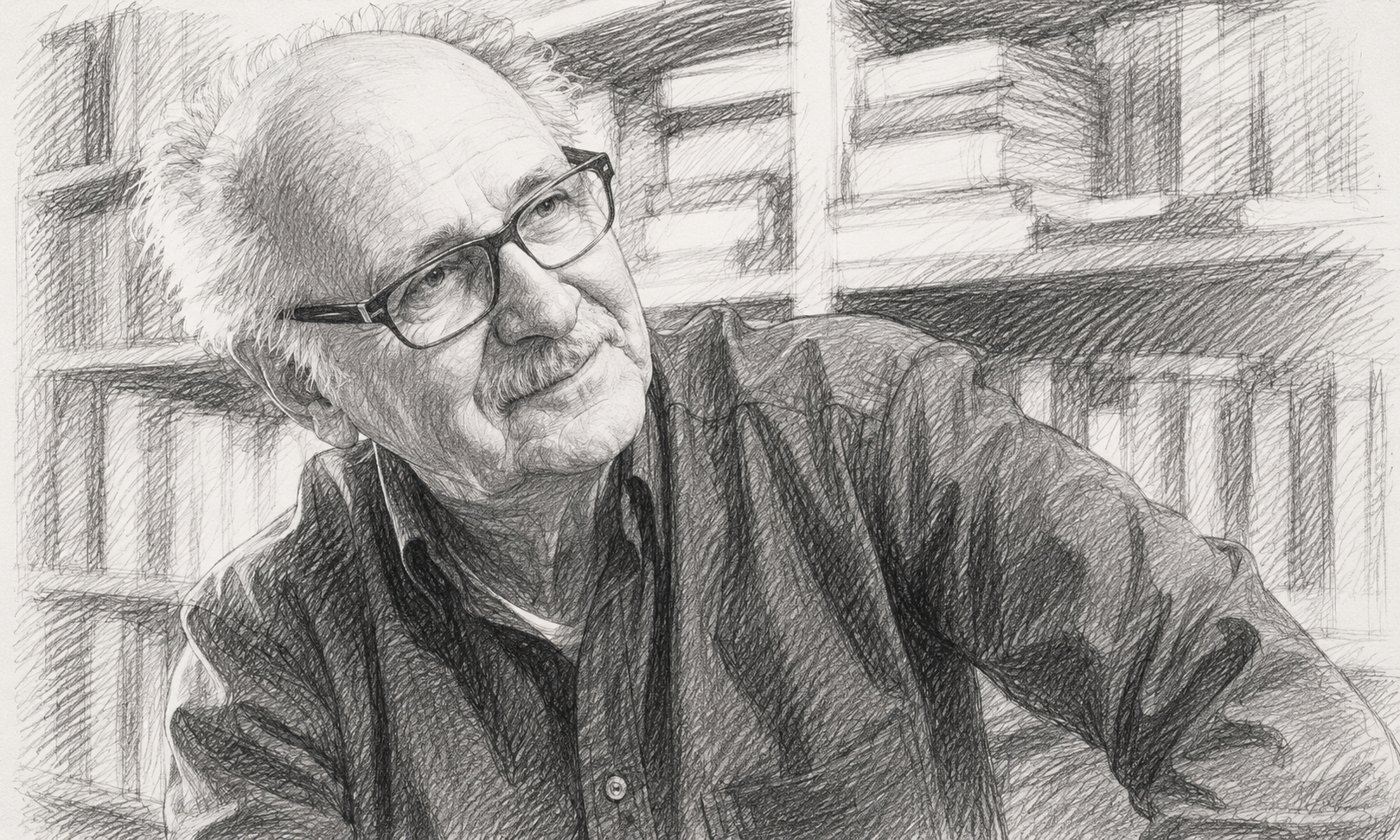
Several years ago, Abdolkarim Soroush told the BBC that some Quranic passages, including those concerning the treatment of women, could not be accepted as the literal word of God. In his account, the Quran is Muhammad’s composition of dream experiences and, as the language of dreams, requires interpretation. Islam thus becomes the product of a singular human experience shaped by a particular geography, language and historical setting: ‘Muhammadan’ in the sense that it cannot be separated from Muhammad as a person.
The proposal is radical. It moves revelation from heaven into history and subjects the text to an individual’s limits. Above all, it allows morally troubling prescriptions in an ancient text to be treated as something other than God’s timeless will. But it displaces two difficulties: what can we know about Muhammad’s consciousness, and can the text we possess be traced without mediation to one man’s experience?
The dream as language
Soroush’s thesis inevitably recalls Freud’s *Interpretation of Dreams*. In the psychoanalytic model, a dream is not a transparent message: it is produced through displacement, condensation and censorship. Making dreams the key to the Quran could therefore lead readers to search the text for Muhammad’s wounds, desires and unconscious conflicts. Such a reading would be speculative. There can be no clinical access to a seventh-century figure, and retrospective psychology is no substitute for history.
The decisive issue lies elsewhere. The dream hypothesis is relevant only if the transmitted Quran corresponds in substance to Muhammad’s speech. If the text was collected, ordered, selected and normalised by several generations, the object to be interpreted is no longer merely the presumed dream of an individual. It is also the product of political, scribal and religious history.
From recitation to codex
In Muslim tradition, revelation extended from 610 until Muhammad’s death in 632. His companions memorised recitations and recorded them on different materials. After his death, the plurality of materials and readings is said to have led Caliph Uthman, in the middle of the seventh century, to establish a reference text and send copies to several cities. Zayd ibn Thabit is traditionally associated with this collection. The account itself exists in Sunni and Shiite variants and must be studied as historical tradition rather than repeated as a contemporary transcript.
Orality was crucial, as the word *qur’ān*—recitation—suggests. It did not entail an absence of writing. Manuscript evidence now allows scholars to follow the text’s transmission from the middle of the seventh century, only decades after Muhammad’s death. This refutes the idea of a two-century documentary vacuum. It does not prove that a single copy identical in every detail to modern editions existed in 632. 1
The distinction matters. Most early manuscripts belong to a common textual family, often described as the ‘Uthmanic text type’, pointing to a very early normalisation of the consonantal skeleton. Diacritics, vowels, divisions and some readings nevertheless stabilised gradually. Traditions concerning the codices of Ibn Masud, Ubayy ibn Kab and other companions, along with debates over the order and number of suras, preserve evidence of plurality before or at the margins of that normalisation. 2
Hossein Modarressi has shown that debates over textual integrity also appeared in early Shiite traditions. 3 In the 1970s, John Wansbrough proposed a much later date for the Quran’s formation. His work shaped revisionist scholarship, but early manuscripts and later research make its strongest form—a canonisation occurring only two centuries after Muhammad—untenable. It remains an episode in historiography, not the present scholarly consensus. 4
The order of the suras follows neither a biography of Muhammad nor the chronology of revelation. It brings together units of different lengths and periods; the Meccan and Medinan categories are themselves products of interpretive traditions. The Quran provides little material for a continuous biography of its preacher. This discontinuity opens a field for exegesis, but it does not turn every textual difficulty into evidence of late fabrication.
Uthman, Abd al-Malik and revisionist hypotheses
Another hypothesis makes the Umayyad reign of Abd al-Malik at the end of the seventh century the decisive moment in the Quran’s fixation and in the emergence of an imperial religion distinct from Christianity and Judaism. In the early twentieth century, Paul Casanova argued that Abd al-Malik and his governor al-Hajjaj produced the first official text and retrospectively attributed the recension to Caliph Uthman. Later scholars have revised or qualified this proposal. 5
Abd al-Malik’s reign was unquestionably a major stage in Islam’s public assertion: monetary reform, administrative Arabisation and the inscriptions of the Dome of the Rock in Jerusalem. Those inscriptions, dating from the 690s, name Muhammad and advance religious claims in a setting shaped by Christianity. They show that the Prophet’s figure and Quranic formulations were publicly circulating at that time. They do not show that Abd al-Malik invented Muhammad or composed the Quran from scratch.
Claims that Muhammad was a wholly legendary figure, or that no relevant evidence exists before the eighth century, belong to the most radical edge of revisionism. The relative scarcity of contemporary biographical sources remains a real problem. The major biographies and hadith collections were written later and reconstruct the past through the concerns of established communities. Yet seventh-century inscriptions, coins, papyri and manuscripts require us to distinguish justified criticism of traditional narratives from wholesale denial of surviving evidence.
A further simplification must also be discarded: Quranic Arabic was not an artificial language created in Iraq by grammarians of Iranian origin. The later development of Arabic grammar and philology owes much to scholars in Abbasid Iraq, including Sibawayh. The Quranic text nevertheless belongs to the history of early Arabic and its varieties within the linguistic world of late antique Arabia.
What the Sanaa manuscripts actually establish
The discovery in 1972-73 of thousands of fragments in the Great Mosque of Sanaa transformed the study of early Qurans. The most famous witness is a palimpsest: a lower text was erased and overwritten with a version closer to the dominant tradition. Its lower text contains variants in sequence, wording and formulation that attest to a different recension. It remains an exceptional witness to early textual plurality.
It does not establish that all the Sanaa manuscripts differ radically from the known Quran, or that they systematically read ‘he said’ where the canonical text has the imperative ‘say’. Palaeographic and philological research supports two simultaneous conclusions: very early normalisation visible in the overwhelming majority of early manuscripts, and the survival of variants or recensions gradually excluded by that process. The discovery makes the text’s history more complex; by itself, it does not validate a single theory of origin.
The 1924 Cairo edition was therefore not the Quran’s first unification. For modern education and printing, it standardised one orthography and one reading—Hafs from Asim—drawn from a much older tradition. Treating it as the text’s original formation erases more than twelve centuries of transmission, canonical readings and manuscript practice.
Muhammad, the kāhin and the danger of retrospective psychology
Maxime Rodinson placed Muhammad’s preaching within the religious world of late antique Arabia, where inspired poets and *kāhins*—seers or specialists in oracular speech—uttered rhythmic formulations and invoked invisible powers. Muhammad’s opponents compared him to a poet, a seer or a possessed man, comparisons the Quran itself rejects. The analogy illuminates an available cultural form; it is neither a medical diagnosis nor proof that revelation can be reduced to pathology. 6 7
We can therefore see why Soroush speaks of dreams. He seeks a language that accounts for religious experience without assigning every word directly to God. But the metaphor creates a new authorised interpreter: the person who knows how to decipher the Prophet’s dream. Clerical authority may simply give way to that of the philosopher, psychoanalyst or hermeneut, without making the criteria for choosing between interpretations more democratic.
The political question remains
Criticism of literalism is essential when an ancient text is used to justify inequality between women and men, religious coercion or immutable law. It is not, by itself, a foundation for liberty. A free society does not depend on discovering the one correct interpretation of the Quran. It rests on equal citizenship, a distinction between conviction and law, the right to believe or not to believe, and the freedom to submit every human norm to public scrutiny.
The Quran may be read as revelation, recitation, literary work, archive of late antiquity or trace of religious experience. The history of its formation makes every exclusive reading more difficult. Soroush’s lasting contribution may therefore be something other than proving that the Quran was a seer’s dream. His controversy exposes a political truth: no asserted sacred origin should place a human rule beyond criticism, and no class of interpreters may claim a monopoly over public meaning.