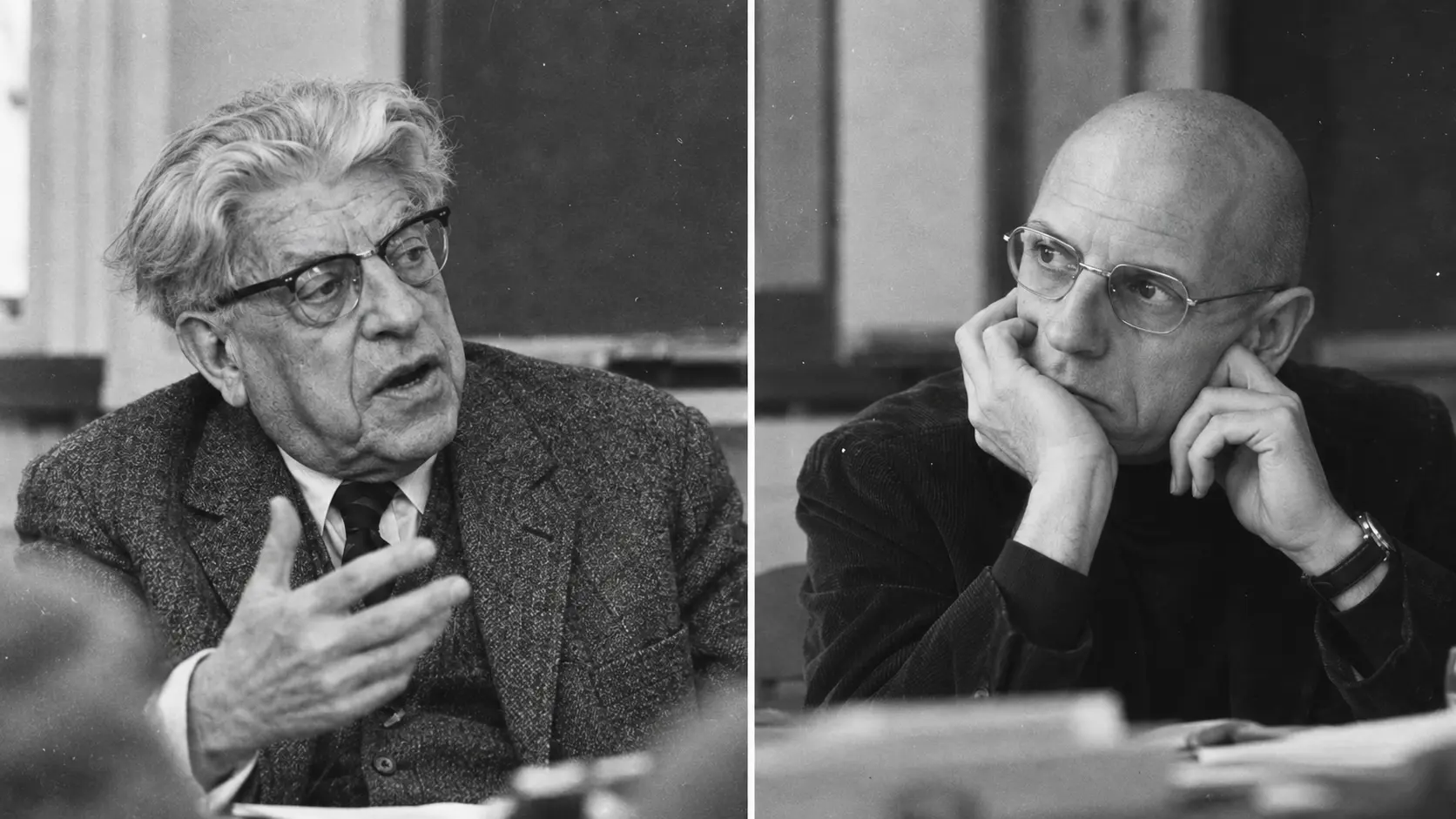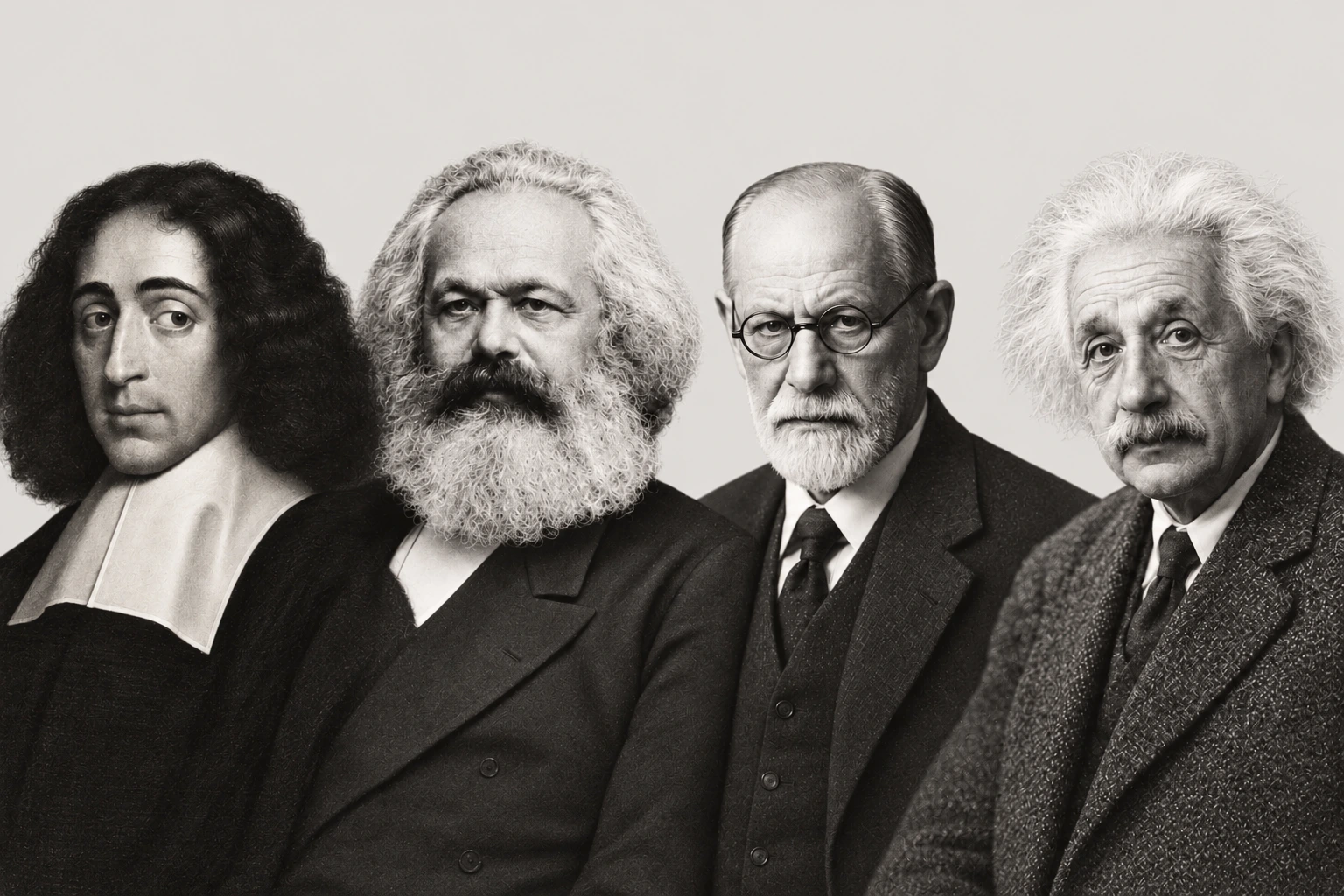
These contributions cannot be explained by some collective genius transmitted unchanged across the centuries. They must be understood through historical experiences: dispersion, persecution, encounters between cultures and the new possibilities opened by emancipation. That history generated different, sometimes conflicting aspirations: to become equal members of existing societies, to transform those societies so that equality became a reality, or to seek in a national homeland the security they had failed to provide.
The tension between a particular belonging and universal emancipation is central to an important strand of Jewish intellectual history.
Dispersed communities, cultures in conversation
In antiquity, Judaism was more than a religion. It brought together religious observance, law, collective memory and forms of political belonging, with Jerusalem as a major centre. Conquest and dispersion transformed the relationship between these elements.
The diaspora already existed before the Romans destroyed the Temple in Jerusalem in 70 CE. The suppression of the Bar Kokhba revolt in 132–135 intensified displacement and brought a prohibition on Jews residing in Jerusalem. It did not, however, eliminate Jewish life throughout the region or turn Jews into an exclusively religious community. Rabbinic Judaism sustained collective life without territorial sovereignty through study, law, communal institutions and shared memory.
Dispersion exposed Jewish communities to insecurity. It also brought them into contact with different languages and traditions. Their intellectual history is inseparable from their encounters with Persian, Greek and Arabic cultures, and with the Christian societies of Europe.
Jewish life in Persia dates back to antiquity. Communities developed a Judeo-Persian literature and participated in the country’s economic and cultural life. Their circumstances varied considerably under different dynasties and local authorities. Under Muslim rulers, the status of dhimmi combined certain protections with legal subordination. Persecution and forced conversion, notably under the Safavids and in Mashhad in 1839, rule out any idealised account of coexistence. Yet violence alone cannot explain centuries of shared life.
Jewish history in Muslim societies involved enduring relationships and cultural exchange alongside hierarchies that were sometimes brutally enforced. Christian Europe presented a different, but equally uneven, history.
Christianity received legal recognition under Constantine and Licinius in 313 and became the imperial religion under Theodosius in the late fourth century. Christian anti-Judaism was more than a theological dispute: it helped legitimise restrictions and exclusions whose severity varied over time.
From the High Middle Ages, occupational restrictions and barriers to entry into certain trades contributed, in several regions, to the concentration of Jews in commerce, peddling and moneylending. This pattern applied neither to all Jews nor to every territory. It cannot justify treating a historical situation as evidence of a collective disposition towards money.
The First Crusade was accompanied by massacres in the Rhineland in 1096. The Second Crusade, in 1147–1149, brought renewed persecution. During the Black Death in the fourteenth century, accusations that Jews had poisoned wells led to massacres. These allegations joined other calumnies, including the accusations of ritual murder that had appeared in medieval Europe by the twelfth century.
Persecution did not prevent intellectual exchange. It made its conditions precarious: protection could be withdrawn, communities expelled and works condemned.
From Maimonides to Spinoza: transmission, interpretation and rupture
Medieval Jewish culture flourished in the Arabic-speaking world, particularly in the Iberian Peninsula. Its creativity grew through encounters between Jewish traditions, Greek philosophy and Arabic philosophical and theological debate.
Moses Maimonides’ Guide of the Perplexed is a major example. Written in the late twelfth century in Arabic using Hebrew characters, and subsequently translated into Hebrew and Latin, it examines the relationship between philosophical reason and revelation. Maimonides did more than introduce Aristotle into Jewish thought. He reformulated religious problems within a shared philosophical culture. His influence subsequently extended to Christian thinkers.
The intellectual flowering of Andalusian Jewry, generally dated to the tenth through twelfth centuries, was inseparable from its Arabic cultural environment. Cultural exchange, however, did not mean religious equality. Remarkable intellectual achievements could coexist with unequal legal status, while coexistence itself could give way to persecution.
The massacres of 1391 in Iberia, the expulsion from Spain in 1492 and the forced conversions in Portugal in 1497 shattered these worlds. Sephardic Jews dispersed across the Ottoman Empire, North Africa and Italy, and later to the Netherlands and England. Some joined established communities; others helped create new ones.
Among converts to Christianity—the conversos—some secretly maintained Jewish practices, while others embraced their new religion. The Inquisition pursued those suspected of practising Judaism. Public belonging and private conviction could become dangerously divided.
Converso ancestry should not, however, be treated as proof of a concealed identity. Genealogical research traces Montaigne’s maternal ancestry to a family of converts of Jewish origin. That ancestry does not, by itself, explain the Essays.
In the seventeenth century, Amsterdam became an important centre of Sephardic life. The relative security and economic opportunities offered by the Dutch Republic did not amount to unrestricted freedom. Jewish communities also exercised authority over their own members.
Spinoza’s life brings this contradiction into focus. Born into a Portuguese Jewish family, he was educated within Amsterdam’s Jewish community, which expelled him in 1656. His philosophy developed at the intersection of that inheritance, Cartesian thought and Dutch religious and political debates.
In the Ethics, Spinoza radically challenged the conception of a personal God existing outside the world. His identification of God with Nature cannot simply be equated with atheism without further argument. It nevertheless transformed the relationship between God, the world and human beings. His critique of theological authority also helped establish the possibility of philosophical freedom beyond religious control.
Spinoza belongs to Jewish intellectual history through his education and the questions he confronted, as well as through his break with communal authority. An inheritance can survive through the challenge made to it.
Entering modernity, questioning its promises
Sephardic migrations helped develop commercial networks linking Mediterranean and Atlantic societies. Linguistic knowledge, family connections and geographical dispersion could facilitate trade. Success also depended on legal rights, economic institutions and relations with political authorities.
In The Jews and Modern Capitalism, first published in German in 1911, Werner Sombart attributed a decisive role to Jews in the rise of modern capitalism. Engaging with Max Weber, he sought to connect forms of economic behaviour with religious traditions. His thesis remains significant in the history of social thought; it cannot be accepted as an established explanation. Its generalisations have been extensively criticised and often reproduce the categories they claim to explain.
The participation of some Jews in commerce and finance coexisted with widespread poverty within Jewish communities. A society might welcome merchants whose capital it needed while excluding other Jews from occupations and civil rights. Emancipation was no automatic reward for contributing to prosperity.
European debates about toleration and, later, civic equality raised a more fundamental question: should an individual’s rights continue to depend on religion? The answers remained incomplete. Locke defended toleration while excluding atheists and withholding it from religious affiliations that, in his view, entailed allegiance to a foreign political authority—an argument directed particularly at Catholics. Universal principles did not immediately remove the boundaries placed on their application.
Jewish emancipation exposed this contradiction. Legal equality promised citizenship; prejudice and discrimination could still treat Jews as outsiders. Acceptance sometimes required an affiliation to become invisible, even as society continued to hold it against those who bore it.
Hannah Arendt’s essays collected in The Hidden Tradition, particularly her account of the Jew as pariah, illuminate this predicament. The issue was more than a choice between assimilation and remaining apart. It concerned the terms on which someone could enter society and the price of admission.
An important part of the Jewish contribution to modern thought developed in this space: participation in existing cultures alongside criticism of societies whose universalism remained selective.
From Jewish emancipation to human emancipation
The debates about the Jewish question in the 1840s marked an important moment in this history. Bruno Bauer and Karl Marx addressed it within the controversies of the Young Hegelians, whose intellectual milieu also included Feuerbach and Stirner. These thinkers were not all Jewish. The debate belonged to a shared philosophical world.
Bauer linked emancipation to the critique of religion and called on Jews, in particular, to relinquish their religious particularity. Marx countered that political emancipation was compatible with the continued existence of religion. Equal rights did not require individuals to abandon their beliefs.
Marx immediately pushed the argument further: was equality as citizens sufficient if material dependence and inequality persisted in society? The distinction between political emancipation and human emancipation became a driving concern of his thought.
“On the Jewish Question” nevertheless remains an ambivalent text. Its defence of political emancipation includes formulations associating Judaism with money and commerce. These must remain open to criticism, even though Marx’s wider project cannot be reduced to them.
During the same period, Marx began to assign the proletariat a universal emancipatory role: its liberation would require the transformation of social relations. He invented neither the word nor the class. His understanding of its historical role drew on German philosophy, socialist thought and the analysis of social conflict.
The movement from a particular emancipation towards human emancipation nevertheless connects these writings. Can it be understood as a transformation of messianic expectation into revolutionary hope? Karl Löwith’s interpretation illuminates this dimension of modern philosophies of history, without providing a sufficient explanation of the origins of Marxism.
In Ernst Bloch and Walter Benjamin, the relationship between Marxism and messianism becomes more explicit, though it takes different forms. Bloch’s philosophy of hope and Benjamin’s reflections on historical time cannot be equated with faith in automatic progress. For Benjamin especially, justice towards the defeated requires challenging accounts of history that justify its victims’ suffering by appealing to a future fulfilment.
This encounter between religious motifs and revolutionary thought later informed the work of Michael Löwy and Daniel Bensaïd. It helps us examine what enables political hope to resist resignation. It does not make socialism merely a secularised form of Jewish religion.
The power of communism in the twentieth century nevertheless owed something to its promise of deliverance in this world. Its claim to embody the meaning of history could acquire a quasi-religious character. Such a description must be grounded in specific practices: the cult of the party, the justification of present sacrifices by a promised future, and the transformation of doctrine into state truth. It should not obscure the social conflicts and emancipatory aspirations that also sustained communist movements.
Internationalism and persecution
The involvement of many Jews in socialist movements also had concrete political explanations. In the Russian Empire, restrictions on Jews and antisemitic violence made the need to transform the existing order particularly immediate.
Some joined Russian revolutionary movements; others defended autonomous Jewish working-class organisation. Founded in 1897, the Bund was a socialist workers’ party and movement committed, among other things, to Yiddish and cultural rights. It demonstrates that socialism did not necessarily require the abandonment of particular affiliations.
Leaders of Jewish origin held important positions among both Bolsheviks and Mensheviks. Their presence did not make these movements a Jewish enterprise. Antisemites nevertheless used it to construct the myth of an international conspiracy.
Modern antisemitism could thus blame Jews for both capitalism and revolution. The contradiction reveals how the accusation worked: individuals pursuing opposing projects were attributed an imaginary collective purpose. Nazism made “Judeo-Bolshevism” central to its worldview. In France, hostility towards Léon Blum likewise combined antisocialism with antisemitism.
Despite the bureaucratisation of the Soviet Union, Trotsky continued to defend an international revolutionary perspective. After the war, Ernest Mandel developed a Marxist analysis independent of Stalinism. Their lives, like those of other activists from Jewish backgrounds, belong to the history of socialism. They do not establish a revolutionary vocation inherent in the Jewish people.
Jewish participation in expanding economic exchange and in socialist criticism of society presents a fruitful historical tension. It requires us to examine contrasting trajectories within the same communities. It does not warrant assigning Jews two collective missions: globalising capital and universalising emancipation.
Works that transformed the world
The contribution of thinkers from Jewish backgrounds to modern culture is considerable. Marx transformed the analysis of society and capitalism; Freud reshaped our understanding of psychic life; Einstein revolutionised physics. Their relationships with their Jewish origins differed, as did their subjects and methods.
The scale of their intellectual breakthroughs invites comparison. It cannot be explained by a common identity. Their work also emerged from controversies, scientific institutions and intellectual traditions extending beyond that identity.
In the arts, Modigliani, Chagall, Mahler, Schoenberg and Kurt Weill illustrate different relationships between family inheritance, education, conversion, exile and artistic creation. Patronage by certain Jewish families also contributed to cultural life in European cities. That social history must be distinguished from the backgrounds of the artists themselves.
American cinema offers another example. Jewish immigrants, including Adolph Zukor, Carl Laemmle and the Warner brothers, played a major role in establishing the large studios. Their achievements also reflect migration, American society and the opportunities offered by a new industry. Cinema did not emerge from a single community, but several of its major institutions owe much to these entrepreneurs.
Chaplin, who was not Jewish, made the Jewish barber in The Great Dictator a figure of persecution and resistance to dehumanisation. His portrayal is a reminder that historical experiences can be understood, represented and defended beyond the boundaries of belonging.
National refuge and the universal promise
Modern Zionism was one response to persistent antisemitism and the limits of integration. It did not originate solely in the Dreyfus affair. The Lovers of Zion organisations developed in the 1880s, notably against the background of pogroms in the Russian Empire. Herzl subsequently gave the project of a Jewish state a new political and diplomatic form.
This response broke with the expectation that European societies alone would secure emancipation. It maintained that Jews needed political power of their own to guarantee their safety. Yet Zionism was never a homogeneous project. Socialist, religious, liberal and nationalist currents contested its direction. Labour Zionism became a major force; some Orthodox Jews opposed the project, while religious Zionists supported it.
Internationalism was therefore not simply replaced by nationalism. Some socialists embraced Zionism; others opposed it. Some sought to combine national construction with social transformation. Their disagreements concerned the means of emancipation as much as the meaning of belonging.
The Holocaust, in which Nazi Germany and its collaborators murdered six million Jews, tragically transformed the terms of this debate. Extermination demonstrated the collapse of protection for Jews across much of Europe. It intensified the urgency of refuge without being the sole origin of Zionism or making the creation of Israel historically inevitable.
The establishment of a Jewish state in Palestine nevertheless encountered another national reality. The pursuit of Jewish security came into conflict with the rights and aspirations of Palestinian Arabs. The war of 1948, the Palestinian exodus and expulsions embedded this contradiction in the histories of both peoples.
This history cannot be reduced to a contrast between a universalist diaspora and an inherently closed national state. Diaspora communities were not invariably universalist, nor was Zionism devoid of egalitarian aspirations. Yet the passage from minority status to the exercise of political power raises a decisive question: how can one people’s national emancipation avoid being achieved at another’s expense?
Memory does not settle the question of justice
The Israeli-Palestinian conflict has also been used to disseminate antisemitism in the Middle East. The Islamic Republic of Iran has made hostility towards Israel central to its ideology and circulated explicitly antisemitic themes, including Holocaust denial and minimisation. This policy should be distinguished from Iranian society and from the history of Muslim-Jewish relations.
The Quds Force is the Islamic Revolutionary Guard Corps’ organisation for external operations. It cannot accurately be described as having been created solely to destroy Israel. Its functions must be distinguished from the regime’s slogans, some of which call for the disappearance of the Israeli state.
The intellectual legacy considered here places no special obligation of virtue on Jews. Its continuing force lies in thinkers who drew on particular experiences to examine the conditions of freedom and justice for everyone. For some, exclusion encouraged the pursuit of an emancipation extending beyond their own community.
That legacy remains alive in the tensions between memory and the future, belonging and freedom, self-protection and recognition of the rights of others. No history of persecution can resolve these contradictions by itself. It makes their examination all the more necessary.
Selected bibliography
Hannah Arendt, La Tradition cachée. Le Juif comme paria, translated by Sylvie Courtine-Denamy, Paris, Christian Bourgois, 1987.
Élie Barnavi (ed.), Histoire universelle des Juifs. De la Genèse à la fin du XXe siècle, Paris, Hachette, 1992.
Daniel Bensaïd, Walter Benjamin, sentinelle messianique, Paris, Plon, 1990.
Georges Bensoussan, Une histoire intellectuelle et politique du sionisme, 1860-1940, Paris, Fayard, 2002.
Neal Gabler, Le Royaume de leurs rêves. La saga des Juifs qui ont fondé Hollywood, translated by Johan-Frédérik Hel Guedj, Paris, Calmann-Lévy, 2005.
John Locke, Lettre sur la tolérance et autres textes, translated by Jean Le Clerc, introduction and notes by Jean-Fabien Spitz, Paris, Flammarion, 1992.
Karl Löwith, Histoire et Salut. Les présupposés théologiques de la philosophie de l’histoire, translated by Marie-Christine Challiol-Gillet, Sylvie Hurstel and Jean-François Kervégan, Paris, Gallimard, 2002.
Michael Löwy, Rédemption et utopie. Le judaïsme libertaire en Europe centrale. Une étude d’affinité élective, Paris, Presses universitaires de France, 1988.
Karl Marx, Œuvres, vol. III, Philosophie, edited, introduced and annotated by Maximilien Rubel, Paris, Gallimard, “Bibliothèque de la Pléiade”, 1982; especially “Sur la question juive” and “Contribution à la critique de la philosophie du droit de Hegel. Introduction”, originally published in 1844.
Moses Maimonides, Le Guide des égarés, translated from Arabic by Salomon Munk, Lagrasse, Verdier, 1979.
Benny Morris, Victimes. Histoire revisitée du conflit arabo-sioniste, translated by Agnès Dufour and Jean-Michel Goffinet, Brussels, Complexe, 2003.
United Nations, News Centre, Bulletin d’information du 9 décembre 2005, New York, 2005, section on Kofi Annan’s response to the Iranian president’s remarks about the Holocaust.
Afshon Ostovar, Vanguard of the Imam: Religion, Politics, and Iran’s Revolutionary Guards, New York, Oxford University Press, 2016.
Baruch Spinoza, Éthique, translated by Bernard Pautrat, Paris, Seuil, 1988.
Baruch Spinoza, Traité théologico-politique, translated by Jacqueline Lagrée and Pierre-François Moreau, Paris, Presses universitaires de France, 1999.
Enzo Traverso, Les Marxistes et la question juive. Histoire d’un débat (1843-1943), foreword by Pierre Vidal-Naquet, Paris, La Brèche-PEC, 1990.
Francesca Trivellato, Corail contre diamants. Réseaux marchands, diaspora sépharade et commerce lointain. De la Méditerranée à l’océan Indien, XVIIIe siècle, translated by Guillaume Calafat, Paris, Seuil, 2016.
Francesca Trivellato, Juifs et capitalisme. Aux origines d’une légende, Paris, Seuil, 2023.
Daniel Tsadik, Between Foreigners and Shiʿis: Nineteenth-Century Iran and Its Jewish Minority, Stanford, Stanford University Press, 2007.