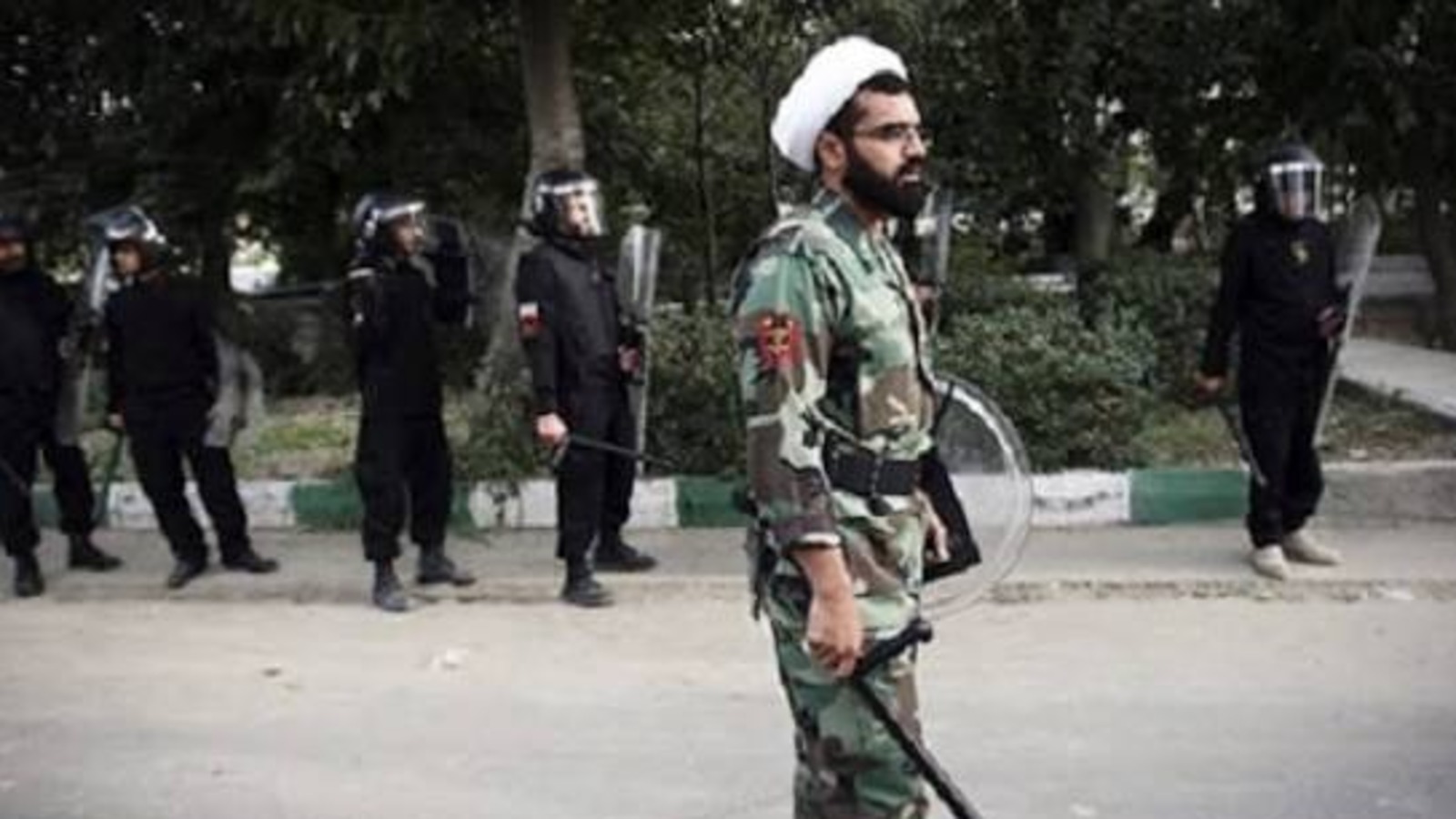
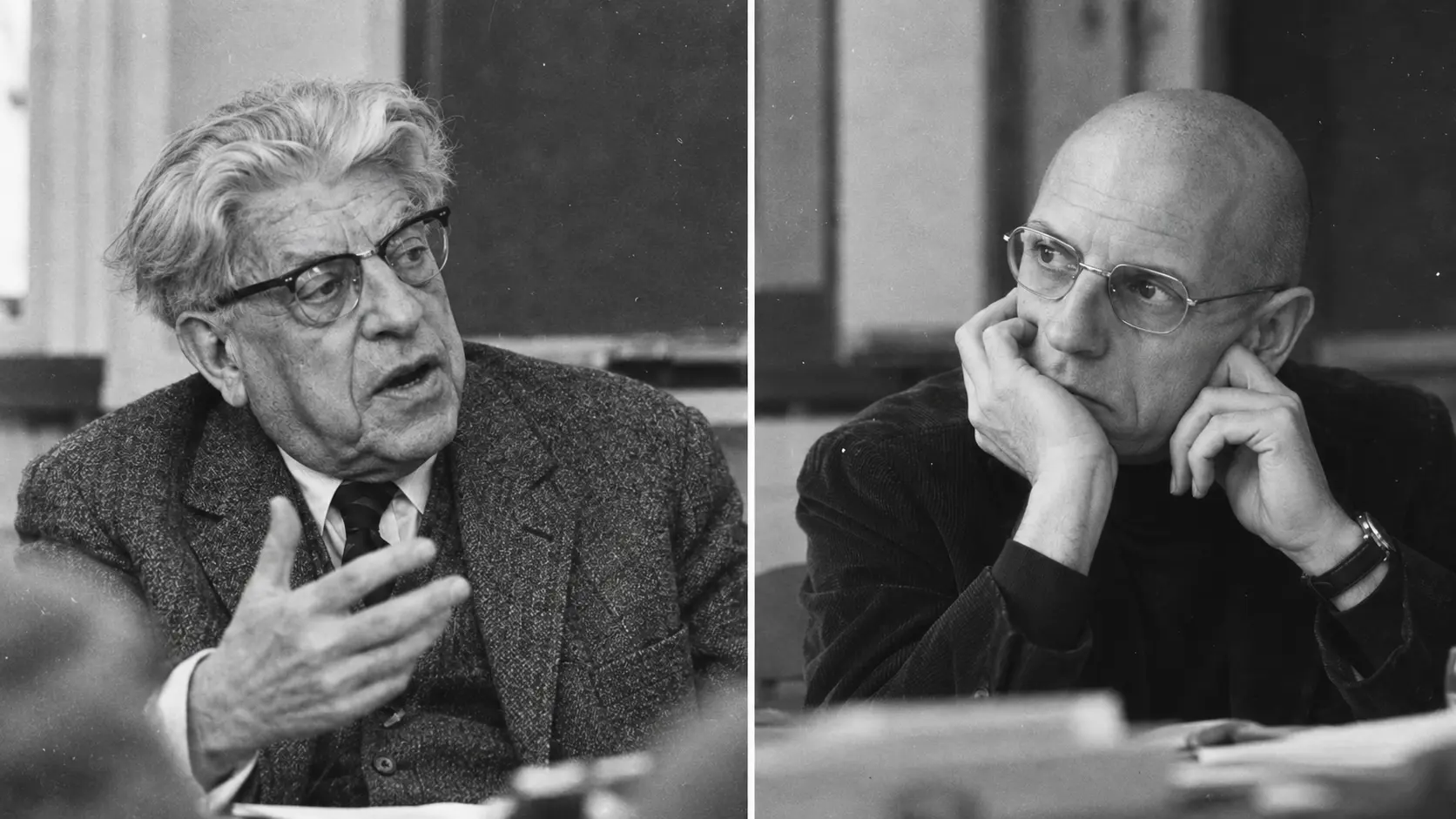
On November 26, 1978, Michel Foucault described the Iranian uprising as a revolt of people confronting the weight of the global order with their “bare hands.” He called it “the first great insurrection against planetary systems” and perhaps the most modern form of revolt.1 The formulation already contained the core of his intuition: Iran was repeating neither the French Revolution, nor the Bolshevik Revolution, nor the familiar pattern of twentieth-century national liberation movements. It might be opening another way of rising against power.
Foucault was trying to break with the Western model of revolution inherited from 1789 and subsequently recast by Marxism. Iran seemed to offer something different: a mass uprising without a revolutionary party directing it, without an established vanguard and without a dominant Western ideology. Religion appeared to have become the language through which a population rejected a monarchy backed by the West and constituted itself as a collective political will.
But Foucault did not arrive in Iran with an unmediated gaze. In an August 1979 interview with the Lebanese philosopher Farès Sassine, he explained that, as the Iranian uprising was gathering force, he had been reading Ernst Bloch’s The Principle of Hope, including Bloch’s reflections on religious revolts in medieval and early modern Europe.2 The coincidence struck him: in Iran, a population seemed to be rising without a Western-style revolutionary organisation to direct it.
This detail is crucial. Foucault did not first encounter the Iranian revolution and subsequently turn to Bloch in search of an explanation. His reading of Bloch preceded his journey and shaped the question he brought to Iran. Foucault would later acknowledge that his way of seeing the uprising had been conditioned by the relationship he perceived between political revolution, religious hope and eschatological expectation.
For Bloch, eschatology was not a marginal theme confined to the history of religion. It ran through his entire philosophy. Hope was neither a psychological mood nor a form of consolation. It was an ontological category: the world remained unfinished and contained possibilities that had not yet become real. Human beings did not merely inhabit what already existed. They anticipated, imagined and struggled to bring into being what the present lacked.
Utopia, in this sense, was not necessarily an escape from reality. It could be an anticipatory awareness of possibilities already latent within it. Dreams, works of art, religious myths and revolutionary movements all carried traces of the “not-yet,” through which societies imagined other ways of living.3
The religious heresies and popular revolts of medieval Europe occupied an important place in this account. Bloch understood them as moments when expectations of salvation were transformed into a determination to change the earthly world. Images of the Kingdom, deliverance and the end of time did not necessarily produce passivity. They could inspire resistance to an existing order and the search for a community freed from domination.
Bloch’s eschatology therefore meant neither a simple return to ancient faith nor the passive expectation of an afterlife. It described the conversion of a transcendent promise into historical energy. Religious hope became revolutionary when it no longer deferred justice entirely to another world and instead sought to anticipate it within this one.
This was precisely what Foucault believed he had encountered in Iran. Shiite Islam appeared to him not merely as an institution or a body of doctrine, but as the language through which a population transformed its rejection of the Shah into a collective will. What observers tied to conventional revolutionary models regarded as an archaic remnant might instead represent an unexpected form of political invention.
What Bloch’s Lens Revealed—and Concealed
Bloch’s influence was not an incidental intellectual detail. It helps explain what Foucault selected from the Iranian event. Where other observers looked for the forces positioning themselves to seize power, Foucault looked for the resurgence of religious hope as a collective political will. This perspective enabled him to perceive, with unusual clarity, the subjective intensity of the uprising. It also pushed a more decisive question into the background: who was organising that fervour, for what purpose and in order to build what kind of state?
The Blochian lens was not false. It was incomplete. Religion was indeed one of the principal languages of popular mobilisation. Mourning ceremonies, the narrative of martyrdom and religious networks gave the opposition a symbolic force and an organisational capacity that Iran’s repressed political movements no longer possessed. Yet those networks were not merely vehicles of hope. They were also the infrastructure of an organised force.
By concentrating on the lived experience of revolt, Foucault underestimated the dominant position already acquired by the Shiite clergy, the authority accumulated by Ayatollah Ruhollah Khomeini and the concrete political content of Khomeini’s project. The doctrine of the rule of the Islamic jurist, which Khomeini had set out years before the revolution, was not a vague form of political spirituality. It proposed an architecture of government in which religious authority would command the state.4
The clerical victory was not inevitable. The movement against the Shah brought together religious activists, liberals, nationalists, Marxists, students, workers and social groups with profoundly different aspirations. But these forces did not possess equal resources, equal networks or an equal capacity for organisation. Recognising the openness of a revolutionary moment does not remove the need to examine which actors are best positioned to close it.
Foucault’s expectations also grew out of his broader critique of Western modernity. In Discipline and Punish, he had examined modern disciplinary institutions, mechanisms of normalisation and the political management of bodies.5 In his lectures at the Collège de France, he described a “normalising society” in which disciplinary power over individuals converged with the regulation of populations.6
The Iranian uprising appeared to emerge from outside that bureaucratic and technocratic world. During his two visits to Iran, in September and November 1978, Foucault was less interested in the programmes of political organisations than in the experience through which people became willing to risk their lives.7 In “What Are the Iranians Dreaming About?” he called this experience a form of “political spirituality.”8
Bloch’s thought therefore converged with a distinctly Foucauldian concern. Bloch offered a historical precedent for religious revolts sustained by hope. Foucault’s own critique of modernity made him receptive to the possibility that a force outside Western rationalism might invent another way of inhabiting political life. Both perspectives directed his attention toward what the uprising made possible rather than toward the power seeking to determine its outcome.
Foucault was not entirely unaware of the danger of clerical rule. In his interviews, he acknowledged the ambiguity of the proposed “Islamic government.” His mistake was not that he never perceived the possibility of theocracy. It was that he underestimated its probability, its institutional resources and the speed with which it could be established.
The weakness of his position was already visible in November 1978, when an Iranian woman writing under the name Atoussa H. warned that Islam might become a new “lead weight” imposed upon Iranian society.9 Foucault’s response did not fully confront the objection. He was principally concerned that warnings about religious power might be used to discredit the uprising against the Shah. That concern was understandable. But it prevented him from recognising that one could criticise both the existing dictatorship and the authoritarian power already taking shape within the movement opposing it.
After the monarchy fell, Foucault did not simply retreat into silence. He answered his critics in March 1979. In April, he addressed an open letter to Prime Minister Mehdi Bazargan denouncing summary trials, executions and human-rights violations. On May 11, in “Useless to Revolt?”, he rejected the claim that the subsequent confiscation of a revolt by a new ruling power retroactively deprived the revolt itself of legitimacy.10 The chronology makes it impossible to reduce his response to a silence that amounted to an admission of guilt.
He nevertheless never offered a full reconsideration of the conceptual framework that had shaped his initial interpretation. He condemned practices of the new regime without completely returning to the question raised by his own account: how had the political spirituality in which he placed such hope become, so rapidly, a principle of domination?
His difficulty was both political and theoretical. To concede that the religious movement already contained a project of government would have weakened the distinction he drew between the truth of the uprising and the order that succeeded it. Yet to identify the uprising entirely with its theocratic outcome would have produced the opposite error by denying the plurality of aspirations that brought millions of Iranians into the streets.
The challenge was to understand the relationship between those two realities without collapsing one into the other. The Islamic Republic was not the necessary expression of every aspiration present in 1978. Nor was it entirely external to the revolution. It was built by the force most capable of converting the uprising’s symbols, networks and religious authority into institutions of domination.
Here the limit of the Blochian lens becomes clear. It could explain how religious hope might mobilise a society against an apparently immovable order. It was less able to explain how that hope could be captured by an organisation, codified in a constitution and converted into a state apparatus. Foucault grasped the power of the revolutionary beginning, but underinterpreted the forces already preparing its closure.
The Iranian experience therefore raises a question larger than Foucault’s political misjudgement. It confronted him with the possibility that a collective hope could become a principle of submission precisely because it promised a radical transcendence of the present. The same transcendence that made it possible to reject an existing order could legitimise a new power claiming to embody the meaning of both history and salvation.
Revolutionary eschatology assumes that beyond the rupture lies a condition in which the contradictions of the present may finally be overcome. In Iran, that promise took the form of an Islamic order said to reconcile justice, community and sovereignty. But once a political authority presents itself as the custodian of such a promise, its adversaries cease to be ordinary political opponents. They can be treated as enemies of the truth that the new order claims to realise.
This reversal is not unique to religion. Modern Western projects of emancipation have also carried eschatological images: the classless society, humanity reconciled with itself, the end of alienation or the disappearance of social antagonism. The promise of final deliverance can sustain resistance to domination. It can also authorise a ruling power to govern in the name of a future whose meaning it claims the exclusive right to interpret.
Toward Emancipation Without Eschatology
Foucault had already distanced himself from grand revolutionary narratives and from the idea of history moving toward a predetermined fulfilment. His ethical turn of the 1980s did not begin with Iran. His lectures on governmentality show that his attention had begun to shift toward the ways human beings are governed even before the Islamic Republic was established.11
It would therefore be excessive to argue that Iran alone produced his later turn toward ethics. No text by Foucault establishes such a direct causality. A more measured hypothesis is possible, however. The Iranian experience may have accelerated or radicalised his distrust of every conception of emancipation presented as the collective fulfilment of a historical promise.
The contrast is striking. In Iran, Foucault had been drawn to a collective will sustained by the prospect of another order. In his later work, emancipation no longer appears as a decisive rupture leading toward a reconciled world. It shifts toward the relationships individuals establish with themselves, with others and with the regimes of truth to which they are subjected.
In The Hermeneutics of the Subject and the final volumes of The History of Sexuality, Foucault studied the practices through which individuals work upon themselves and constitute themselves as subjects.12 In his last lectures, freedom became inseparable from truth-telling, critical speech and the courage not to be governed in the prescribed manner.13
These practices promise no end of history. They announce neither the disappearance of power nor the definitive reconciliation of society. They take place within relations that remain mobile and always capable of generating new forms of domination. Freedom is no longer a final state. It becomes a practice without guarantees that must continually be resumed.
This development can be understood as a de-eschatologisation of emancipation. Foucault did not renounce resistance or the possibility of transforming power relations. He separated them, however, from the promise of ultimate fulfilment. Emancipation ceased to mean a passage into a world delivered from its contradictions. It became a critical labour upon existing forms of government and upon the ways subjects are constituted within them.
The Iranian revolution does not provide the single key to this transformation. It nevertheless constitutes a revealing ordeal. Foucault encountered a revolt whose intensity seemed to confirm Bloch’s insight: religious hope could become a political force capable of overturning a seemingly unshakable order. But Iran also showed that the utopian power of an uprising tells us nothing, by itself, about the freedom of the order that will emerge from it.
The debate should therefore no longer be confined to whether Foucault was right or wrong about Khomeini. His error was neither support for theocracy nor a simple blindness to religion. It lay in an insufficiently developed distinction between the event of revolt and the constitution of power.
Bloch did not cause that error. His thought gave Foucault a framework that illuminated one real dimension of the event while leaving another in shadow. Eschatology helped explain how hope might release a population from obedience. It did not reveal who would capture that energy, how it would be institutionalised or against whom the new order would turn its promise of deliverance.
Nearly half a century after 1979, the lesson remains urgent. A revolt does not contain within itself the form of the world that will follow it. The force capable of destroying an old order does not thereby guarantee freedom or demonstrate the capacity to establish a better one. When the question of power is suspended in the name of the purity of revolt or the grandeur of hope, it does not disappear. It is abandoned to the forces best organised to answer it.
Freedom therefore cannot be reduced to the moment when a people refuses to obey. It also depends on institutions, enforceable rights and limits placed upon those who govern after victory. The Iranian experience points toward another conception of emancipation: without final salvation, without a redemptive subject and without eschatological guarantees—but not without resistance, invention or the courage of truth.