What Ghalibaf’s statement reveals
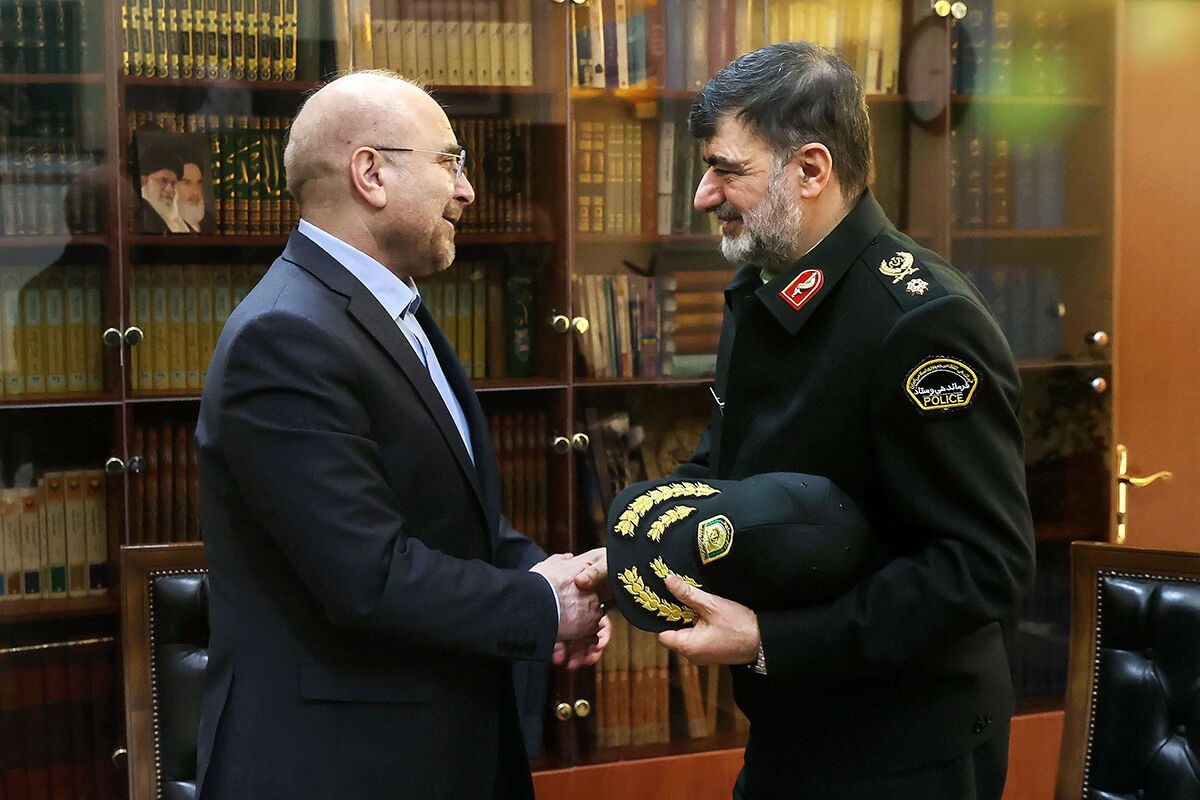
On October 7, 2026, Mohammad-Bagher Ghalibaf, speaker of Iran’s parliament, met Ahmad-Reza Radan, commander-in-chief of the national police. Ghalibaf promised serious measures to improve police infrastructure and the living conditions of its personnel.
“All our efforts are aimed at taking serious action, particularly regarding infrastructure and the living conditions of national police personnel,” he said. He also called on the executive, legislative and judicial branches to cooperate in meeting the needs of the armed forces, especially those of the police.
This was more than an administrative promise. Iran’s military and security institutions have acquired growing influence within the structure of power. When the speaker of parliament publicly stresses the urgency of protecting police living standards, he signals that the issue has become politically sensitive.
During the same period, several members of parliament called for higher salaries for military and police personnel. The nominee for defense minister likewise pledged substantial pay increases, stronger purchasing power for military families, and expanded welfare and pension benefits.
These statements show that the material condition of the armed forces has become a matter of open concern for the authorities of the Islamic Republic.
Bigger budgets, weaker purchasing power
For years, the Islamic Republic has devoted extensive resources to its military and security institutions in order to preserve their operational capacity and internal cohesion. But under high inflation, a larger budget on paper does not necessarily translate into greater financial capacity.
The budget for Iranian year 1404, corresponding broadly to 2025–2026, illustrates the problem. Once ordinary appropriations, oil allocations and special funding are included, projected resources for the Islamic Revolutionary Guard Corps reached approximately 311 trillion tomans—slightly more than $6 billion at the exchange rate used in the budget. The regular armed forces received roughly 177 trillion tomans, or about $3.4 billion on the same basis. These dollar equivalents are approximate because the value changes according to the exchange rate used.
The IRGC was therefore allocated roughly 1.8 times the resources of the regular military. Nearly 47 percent of the military funding examined also depended on oil allocations and special budgetary mechanisms.
These figures show the privileged place of the IRGC in the distribution of state resources. They also reveal the importance of oil revenue and special financial mechanisms in funding Iran’s military institutions.
Banking sanctions, restrictions on oil exports and the U.S. maritime blockade make it more difficult to sell oil and transfer foreign-currency revenue. At the same time, inflation and the depreciation of the Iranian currency reduce both the purchasing power of personnel and the real value of institutional budgets.
The regime therefore faces a contradiction. It must allocate more resources to preserve its military and security capabilities while economic pressure and constrained revenues make those resources increasingly difficult to provide.
The erosion of privileges and material interests
The attachment of forces supporting the Islamic Republic is not based on political and religious convictions alone. Over several decades, the distribution of jobs, public contracts, welfare benefits, commercial opportunities and economic privileges has created an extensive network of interests around military and security institutions.
The IRGC stands at the center of this network. Its companies and foundations operate across the oil, construction, transportation, telecommunications and other sectors. The organization therefore benefits from the state budget while also controlling economic resources and instruments of influence of its own.
Alongside political, ideological and organizational ties, this economic structure has helped preserve the loyalty of sections of the forces connected to the regime.
Economic crisis, however, can reduce the real value of these advantages. Salaried personnel, military retirees and lower-ranking forces are more exposed to declining purchasing power than senior officials and commanders with access to independent economic resources.
At the same time, declining government revenue can intensify competition among military and security institutions for budgets, contracts and welfare benefits.
Economic pressure may therefore reach groups that had previously enjoyed better material conditions than other parts of Iranian society. The scarcer the resources available for distribution become, the more expensive these privileges will be for the regime to maintain.
Social protest and the cohesion of the repressive apparatus
The significance of these developments becomes clearer when considered alongside the possibility of renewed social protest.
The capacity for repression does not depend solely on the number of personnel, their equipment or their firepower. Sustained security operations also require available staff, a cohesive chain of command, guaranteed operating expenditure and personnel confident in their professional and material future.
If demonstrations were accompanied by labor strikes, bazaar closures and civil disobedience, the burden on the security apparatus would rise sharply. Police officers and security personnel would be required to undertake broader and longer deployments while their own families were suffering from inflation, shortages and economic insecurity.
The regime would then face two simultaneous pressures. It would have to devote additional resources to containing protest while also increasing salaries and welfare benefits to prevent the erosion of motivation and cohesion within its own forces.
This contradiction could become particularly important among lower-ranking personnel. Unlike commanders with extensive economic privileges, many police officers and military personnel depend mainly on their salaries and organizational benefits. They face many of the same material difficulties that lead other sections of society to protest.
Large-scale demonstrations could also deepen the tension between the institutional duties of security personnel and their family or social ties. When protesters’ economic demands correspond to the hardships experienced by officers and their own families, maintaining discipline and readiness for repression becomes more difficult and more costly for the command structure.
At the same time, employment dependence and access to exclusive benefits may continue to bind these forces to the preservation of the existing system. The effect of the economic crisis on the cohesion of the coercive apparatus will therefore depend on the government’s ability to provide resources and preserve the privileges of its personnel.
The contradiction at the heart of power
As its social base erodes and military and security institutions gain greater weight within the structure of power, the Islamic Republic has become increasingly dependent on its coercive apparatus. Maintaining that apparatus amid war, sanctions and economic crisis, however, imposes increasingly heavy costs.
The more resources the regime allocates to preserving its capacity for repression, the greater the pressure on other public expenditure. Yet the more living conditions deteriorate, the wider the grounds for dissatisfaction and protest become, increasing the regime’s dependence on security intervention.
The Islamic Republic is consequently trapped in a cycle in which economic crisis increases the need for repression, while greater reliance on repression intensifies pressure on government finances.
This situation also has consequences for the military institutions that now possess greater influence within the structure of power. Their expanding political and economic authority places growing responsibility for the regime’s stability on institutions that are themselves confronting the effects of the economic crisis.
The vulnerability of the Islamic Republic’s security pillar lies in this contradiction. A regime that increasingly ties its survival to military and security forces must, under conditions of economic erosion, preserve both their operational capacity and the material privileges required to maintain their loyalty.
Future social protests will therefore not only test the extent of public dissatisfaction. They may also test the financial resources, organizational cohesion and political capacity of the apparatus on which the Islamic Republic has based its survival.