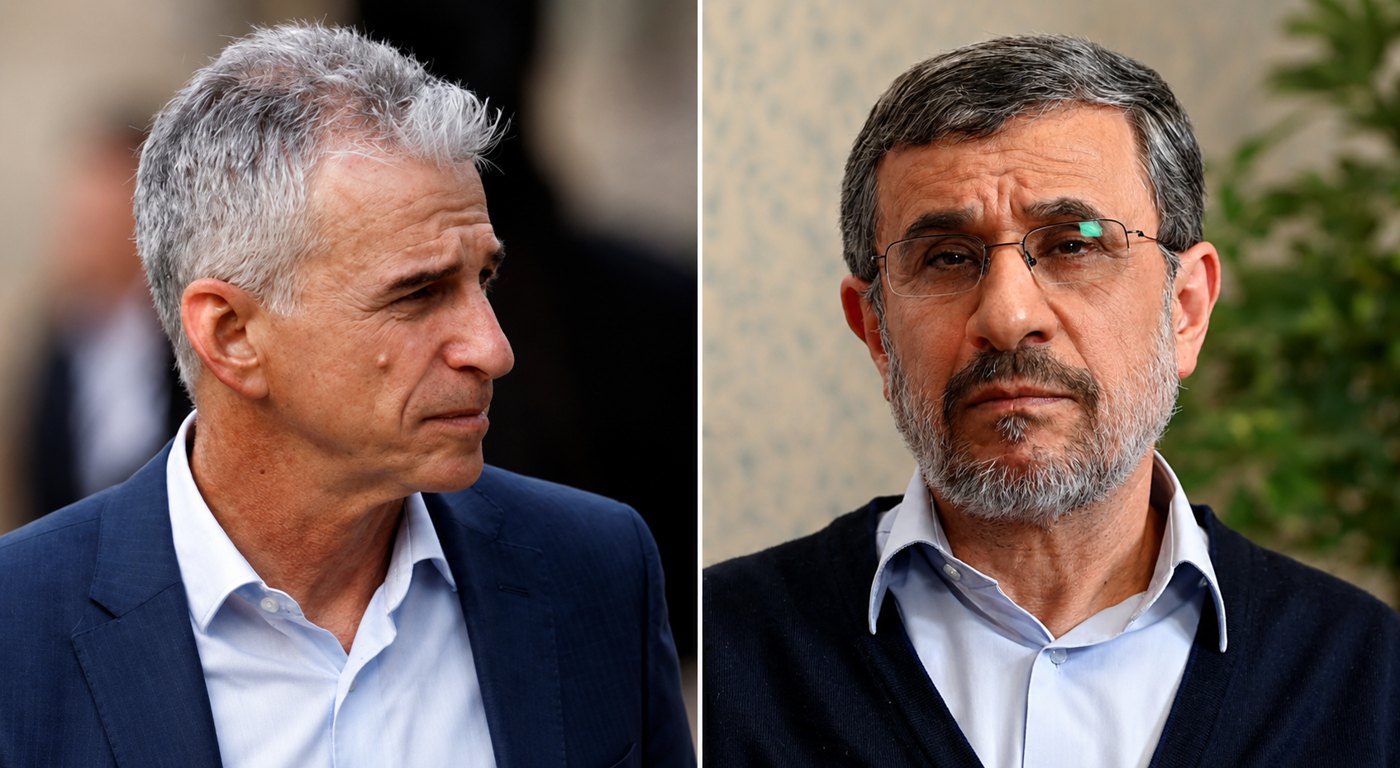
The Ahmadinejad episode was an attempt to solve a structural problem with a personal answer. According to multiple reports, Israeli intelligence explored whether a former president of the Islamic Republic—one who had become increasingly critical of the establishment—could provide continuity after the regime’s collapse while redirecting the state. The attraction is obvious. So is the flaw: an insider can become a successor without becoming the basis of a legitimate transition.
The reported approach
Reporting cited by Le Monde and Israeli outlets says Mahmoud Ahmadinejad had been approached since at least 2024 and met then-Mossad director David Barnea in Budapest. He was later incorporated into a wider concept that included military strikes, Kurdish forces and attempts to trigger defections and protest. Much of the account rests on unnamed officials and intelligence-linked sources. The details should therefore be treated as reported claims, not as an official record released by the governments involved.
Ahmadinejad’s potential value lay in his ambiguity. He belonged to the system, had governed it and retained networks within it, yet had also challenged parts of the establishment. For foreign planners, that combination promised a bridge between regime collapse and state continuity. For many Iranians, the same history would have raised an immediate question of legitimacy: who had authorised him to embody the political future of the country?
The recurring search for a pragmatic insider
Western policy has repeatedly invested in differences among Iranian factions. Presidents, parliamentary leaders and former officials have at various times been treated as possible partners for a more pragmatic relationship. Those differences are not fictitious. They can influence diplomacy, social policy and the degree of confrontation abroad. But they operate inside a constitutional and coercive structure that limits how far an individual office-holder can redirect the system.
The failure of the Ahmadinejad gambit does not prove that all insiders are interchangeable or that internal change is impossible. It does demonstrate that elite substitution and political transition are not the same process. Replacing one leader may change style and policy; it does not by itself create accountable institutions, popular sovereignty or rules for transferring power.
What the June agreement did—and did not—show
The White House announced a memorandum with Iran on 19 June addressing the nuclear issue and navigation through the Strait of Hormuz. Its existence confirmed that coercion and bargaining could still produce an agreement. The subsequent return of confrontation showed how fragile such bargains can be. Neither outcome settles the larger argument. A security agreement can leave authoritarian institutions intact; the breakdown of an agreement does not make externally imposed regime change a democratic strategy.
This is the dilemma behind the search for a ‘third path’ between negotiation and indefinite war. If the answer is merely to identify another figure from within the Islamic Republic, the underlying institutions retain the power to reproduce the same crisis. If the answer is military collapse without a political alternative, the state itself may fragment before a legitimate order exists.
A durable transition would require more than a candidate. It would require organised actors inside Iran, continuity for essential administration, civilian control over armed institutions, safeguards against collective punishment and an agreed process through which citizens determine the constitutional order. Foreign pressure may alter the conditions under which those tasks become possible. It cannot perform them on Iran’s behalf.
The Ahmadinejad story therefore matters less as an intelligence curiosity than as a warning about strategy. The central question is not which insider might inherit the system, but how Iranians can become the authors of an order that no longer reproduces it.