On 25 March 2005, after twenty-one years away, I returned to Iran. I spent nine days at Tehran’s Marmar Hotel. Each evening before bed I recorded the day’s observations. These pages draw on that notebook: a returning exile’s view, with its memories, anxieties and the limits of a brief stay.
The first night
The Air France flight had left Charles de Gaulle after a long delay. We entered Iranian airspace at night. A few dozen kilometres beyond Qazvin, the lights seemed to continue without interruption toward Tehran, as though its outskirts had joined Karaj and then the capital. For the first time, I was arriving at Mehrabad as an Iranian passenger coming from abroad.
An old, dirty bus took us to passport control. At the entrance stood a man in a crumpled uniform, with unkempt hair and several days’ beard. The ceiling’s metal panels were old and partly broken, with wires protruding. Booths and signs seemed to date from before the revolution. Time appeared to have stopped there, as it had in some of exile’s images.
Small television screens announced arrivals and departures. When my turn came, the young officer took my passport without returning my greeting. After typing on his keyboard, he asked whether I had left the country illegally. His brusque familiarity surprised me. I said yes. He made a few confused remarks, stamped the passport and tossed it across the counter. I caught it in the air.
Passengers waited for luggage in the next hall. Outside, families exceeded the space available. An old friend and his wife had come unexpectedly to meet me. Their car was almost on the airport’s access boulevard. In the cold night air, battered vehicles mixed with newer cars assembled from French and Korean brands and the crowd of arrivals.
Under the lights of Azadi Avenue, formerly Eisenhower Avenue, I recognised places. The Firouz school, where I had studied for a year, near the traffic offices, seemed almost derelict. Many facades looked aged, including those of apparently recent buildings.
We stopped at the Marmar, at the junction with former Soraya Street, now Somayeh. Nowruz holidays had emptied the streets, but a strong smell of petrol burned my throat and nose. The hotel’s silence made me fear I was its only guest. The following days did little to dispel the impression.
The sleepy attendant wore a faded brown uniform and plastic slippers. He accompanied me to my room and declined the banknote I offered with a movement of his head. Dust and soot covered the window and greyed its white curtain. The bathroom was dirty. Once a relatively luxurious meeting place for journalists, the hotel now reminded me of the old lodging houses around Nasser Khosrow.
I was exhausted but too anxious to sleep. I swallowed another tranquilliser and wedged a chair beneath the door handle. I feared being surprised in my sleep. I finally slept around two or three and woke at five. After a shower, I went out into the darkness.
Finding the streets again
A cold wind was blowing. I walked without a destination, watching everything eagerly in the weak morning light. A few homeless men, without sufficiently warm clothing, trembled in a corner. Others, collars raised, smoked as they hurried toward a bus stop. Smoking in air already so polluted seemed absurd.
The streets were familiar and foreign. They no longer resembled the images sustained by nostalgia in France. Buildings and roads seemed smaller. The city looked like disordered remnants of a distant past. One novelty nevertheless caught my eye: donation boxes placed one after another along pavements.
Their inscriptions promised to avert misfortunes, prolong life or provide religious protection. I found them even in outlying districts. People told me their proceeds belonged to the charitable apparatus then headed by Habibollah Asgaroladi. What struck me was less each object than the occupation of everyday space by religious promises.
From Goloubandak I walked toward Arg Square, Nasser Khosrow and the Palace of Justice. Religious inscriptions hung on its rusty railings, recommending kindness to parents and condemning unpaid debts or excessive prices. Near the entrance, one declared bribing a judge a major sin. In that location it seemed surreal.
Toward Toupkhaneh, the old walls of Qourkhaneh had disappeared and the site had become a bus terminal. I passed Manouchehri Street and Berlin Alley. Shops were still closed; pollution had greyed the German embassy. After a pause in a cafe on Ferdowsi Square, I continued toward Vali-Asr, formerly Pahlavi.
At College junction, memories of adolescence and lost friends returned. I had once sold books and political publications on its northwestern pavement. Hezbollah groups sometimes came to tear them up and beat me. The place awakened a history the city continued to carry without telling.
The bus to Naziabad
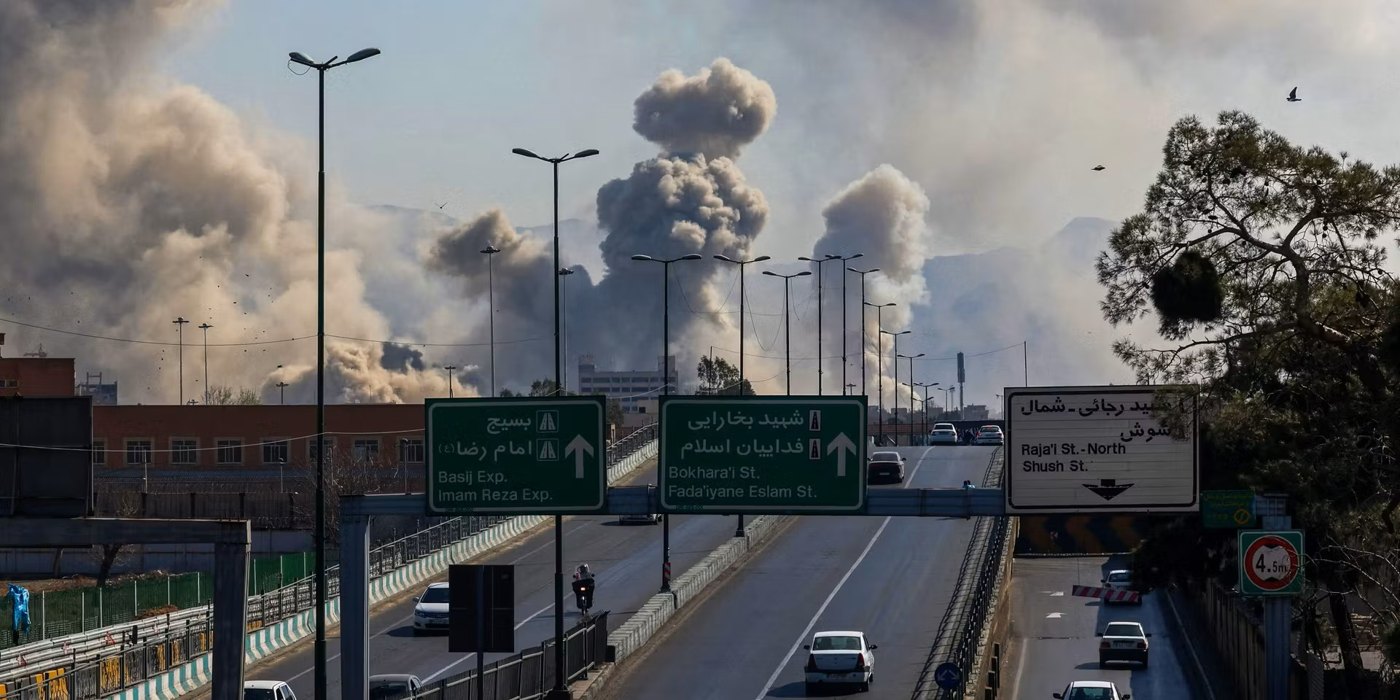
After Hassanabad and the northern entrance to Shahr Park, I boarded a bus to Naziabad, my childhood neighbourhood. It followed former Shahpour Street, now Vahdat-e Eslami, then Shoush and Rajai. At the back, an iron bar separated women from men.
I caught myself avoiding looking toward their compartment, as though involuntarily participating in their erasure. The scene recalled images of racial segregation in South Africa or the United States. The comparison expressed my response to separation; it did not establish that the historical situations were identical.
A few days later, a Tehran intellectual told me that women themselves did not object because of some men’s behaviour. In my recollection, Homayoun Katouzian, also visiting after a very long absence and present at the gathering, agreed. I did not begin an argument. These justifications seemed so close to those of the system they purported to explain.
Before Shoush I saw a young couple arguing. The young woman defended herself boldly. The boy slapped her. The men watching did not protest; instead they tried to soothe him. The scene stayed with me.
Around Pamenar, and later elsewhere, mud-brick houses from the Qajar or Pahlavi periods stood abandoned. Newer construction inspired little more confidence: marble or glass facades dressed buildings whose overall appearance seemed precarious. A friend said he avoided walking beneath certain buildings in his neighbourhood.
Everyday encounters and silence
Traffic also conveyed disorder. Crossing a street required constant vigilance. Once, on a pedestrian crossing, a turning car almost knocked me into the gutter. Its driver continued. I was fortunate that he was not going fast.
The brusqueness of exchanges struck me too, in streets and offices. I noticed abrupt expressions and the frequent absence of customary respect. I read this as a deterioration of relations with others and an echo of authority’s behaviour. It was the notebook’s judgment, formed through those days’ encounters, not a description of every Iranian.
I heard little political discussion in public places. The silence seemed to me to express weariness and lost hope rather than satisfaction. At a reformist newspaper’s offices, a well-known journalist said that if the Americans bombed a few targets, the regime would fall within two days. I did not know how to answer this expectation of salvation from outside.
One night, in a taxi from Zafar to the hotel, the driver learned I had come from abroad. Almost without pausing, he began describing his ability to recognise British spies. The conversation left me with the impression of an imagination saturated by suspicion.
Satellite dishes, by contrast, were visible behind windows. The notebook offered a very high estimate of their prevalence and mentioned a price around 110 dollars. I had conducted no statistical survey. What I could observe was the place satellite television occupied in my interlocutors’ references.
Two cities within a city
In Jordan, Fereshteh and Elahieh, towers rose along very narrow streets. Their facades recalled neighbourhoods in Los Angeles, Paris, Berlin or London; the prices people mentioned seemed comparable. Shemiran’s old garden lanes were disappearing. Deh Vanak still retained some of its earlier fabric.
Around Mahmoudieh, abandoned houses were deteriorating. I wondered about owners and heirs, departures abroad and confiscations. I could not establish each house’s history. The landscape contrasted with the southern city, extending toward the Saveh road and Behesht-e Zahra.
Restaurants in Tajrish and Shemiran stayed full late into the night. I had the impression that religious restrictions had redirected some pursuit of pleasure toward food and outings, according to people’s means. Differences in wealth produced worlds existing alongside one another without meeting.
Young people in the south spent long hours on the streets without an apparent destination. In the north, others drove expensive cars between Elahieh, Jordan and Vanak. Clothes and hairstyles suggested common reference points, often associated with images of the Los Angeles diaspora. Similar appearances did not remove unequal opportunities.
Another night near Shams-ol-Emareh, young men offered what they called medicine, then displayed small packets presented as heroin. Old Cheragh Bargh Street seemed run-down and unsafe. Elsewhere too, bars, metal doors and new security barriers revealed a feeling of insecurity.
At the bazaar, between the shoe sellers, Chaharsouq and Seyyed Esmail, cartons of American cigarettes filled shops and sometimes pavements. In Sabzeh Meydan I saw the shah’s Answer to History. I asked the bookseller which book sold best. He indicated that one. It was one seller’s answer, but its matter-of-factness surprised me.
A Friday at the university
One Friday I walked from Haft-e Tir toward the large hospital, then went to Friday prayers at Tehran University. On the streets I had noticed more police than Revolutionary Guards. I wondered whether their presence provoked less hostility among young people. It was only a hypothesis.
The avenue between Enghelab and Vali-Asr was closed, but the surroundings seemed quiet. Behind the university railings, an older man argued with a young visitor seeking an assistance office. As he left, the young man shouted insults at clerics and officials. The other man did not respond. Such lack of restraint contrasted with my memories.
I underwent two searches before entering. Paving had replaced the men’s former lawn. Before the sermons, a speaker tried to elicit responses to prayers. It felt like a circle whose members knew one another. A man, perhaps recognising me as unfamiliar, shouted against hypocrites.
At that hour, before prayers began, I saw only a few dozen men, generally older. Later a friend said television used archive footage and mosques were mobilised for official ceremonies. I report his words; I had neither verified the figures nor observed the gathering in its entirety.
The cultural distance
I left on foot toward Keshavarz, Vali-Asr and Haft-e Tir. New traditional-style restaurants reproduced the forms of older southern coffeehouses in more polished surroundings. Families, young women and young men gathered there; girls smoked waterpipes alongside boys. Couples held hands in the streets too.
These scenes could suggest an opening. I also sensed an energy searching for outlets. Fear seemed less visible than anger and defiance. A friend worried that the absence of political prospects could leave that energy available to extreme movements. It was his concern, not a prediction.
By the end of the visit, I saw the cultural gap as the regime’s central challenge. Its religious identity and hostility toward the United States seemed so constitutive that normalisation might deprive it of its bearings. The prospect of reopening the American embassy helped me formulate that paradox.
The notebook ended with a fracture: the authorities no longer recognised much of society as their own, and that society no longer recognised itself in them. The conclusion belonged to my return in 2005. It did not say everything about Iran. It said what nine days, after twenty-one years away, had made impossible for me to ignore.